
死亡笔记
国际矿物学协会大会举行 全球学者共话“矿物万象”,国际矿物学协会大会举行 全球学者共话“矿物万象”_我的网站

A | 南京8月24日电 (记者 徐珊珊)第24届国际矿物学协会大会8月20日至24日在南京举行。
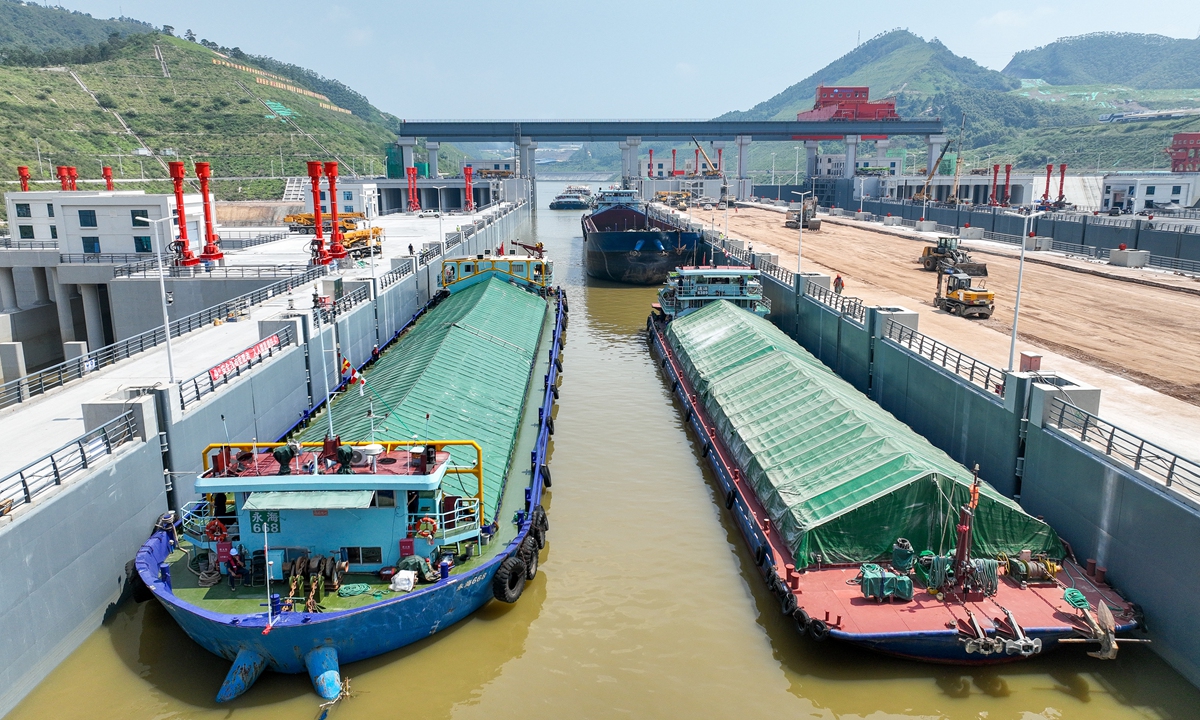
Equipped with China's homegrown BeiDou positioning systems, drones and sensors, four vessels began trial runs along China's Pinglu Canal on Wednesday. The canal, which is planned for opening in September, will greatly inject economic vitality to areas along its route and turbocharge China's trade connection with the ASEAN with its cost-saving transportation, a Chinese analyst said.
The vessels conducting trials on Wednesday represent the main types expected to sail on this canal, namely loaded and unloaded 5,000-tonne ships as well as loaded 3,000-tonne and 1,000-tonne vessels, Xinhua News Agency reported.
The trials began when an unloaded 5,000-ton vessel departed from the Xinfu service area along the canal in South China's Guangxi Zhuang Autonomous Region, the Xinhua News Agency reported.
With sensors collect data on their routes, movements, water currents and safe distances between ships, the tests will assess navigation under both normal and adverse conditions and examine whether the canal's waterways, locks, anchorages, service areas and navigation facilities are ready for operation.
Chinese analysts said the tests starting on Wednesday, days after the canal completed its first full-route patrol, indicated that the canal is one step closer to its scheduled opening in September as final preparation work ramp up.
Zheng Ping, chief analyst at industry news portal chineseport.cn, told the Global Times on Wednesday that as a major project in the nation's water network, the opening of the canal later this year will bring sea changes to areas along its route with fresh economic opportunities with its role as a low-cost enabler for domestic and international trade.
"Inland water traffic has great advantage in transportation capacity and costs. While a train can typically carry 20 40-foot container or more, a waterborne vessel can easily carry over 100 such containers. So a five-times capacity is gained here, greatly reducing transportation costs for goods," Zheng said.
For goods that are not time sensitive, or for bulk cargo such as coal, aluminum or fertilizers, waterborne traffic has unparallel advantage, the expert noted.
The 134.2-kilometer-long Pinglu Canal is a key project of the New International Land-Sea Trade Corridor. With total investment exceeding 70 billion yuan ($10.37 billion), the canal begins at the Pingtang River estuary in Hengzhou, administered by Nanning, follows the Qinjiang River into the Beibu Gulf, according to Xinhua News Agency.
It is China's first major river-to-sea canal project planned and coordinated at the national level since 1949 and is designed to accommodate vessels of up to 5,000 tons.
In addition to facilitating transportation, modern canal system will also have the function of water resource diversion, flood control and irrigation, greatly boosting up local economic development, Zheng said.
Lei Xiaohua, deputy director of the Institute of Southeast Asian Studies at the Guangxi Academy of Social Sciences in South China's Guangxi Zhuang Autonomous Region, told the Global Times on Wednesday that the Pinglu Canal will serve as a new engine for the deep integration of industrial chains between China and ASEAN.
"Raw materials from ASEAN can enter China's hinterland via the Beibu Gulf ports at lower costs, while Chinese exports including aluminum products and building materials can reach Southeast Asia more efficiently," Lei said.
Against the backdrop of deep industrial chain integration between China and Vietnam, the canal, which offers a low-cost, high-capacity transport route, is poised to foster new models of cross-border industrial capacity cooperation, said Lei.
When operational in September, the canal will give inland regions in Southwest China a more direct river route to the sea. Cargo that previously had to travel eastward through the Port of Guangzhou will be able to head south directly toward ports in the Beibu Gulf, shortening some inland waterway journeys by about 560 kilometers, according to Xinhua.
The New International Land-Sea Trade Corridor is an international trade and logistics network connecting China's western regions to ASEAN countries and other overseas markets.
The corridor has continued to record strong trade growth. During the first half of 2026, imports and exports transported through the corridor by its participating regions reached 517.23 billion yuan, up 13 percent year-on-year and setting a new record for the same period, per data released by Chongqing municipal government.
The corridor's rail service handled a record 1.425 million 20-foot equivalent units of cargo in 2025, up 47.6 percent year-on-year. As of early June of 2026, its network reached 593 ports in 128 countries and regions.
。这是该大会继1990年在北京举办之后,再度在中国举办。来自29个国家和地区的700余名专家学者及研究生参会,围绕“矿物万象,共赴新程”的主题展开交流研讨。 本届大会由国际矿物学协会、南京大学和中国矿物岩石地球化学学会共同主办,设置40余个专题分会场,重点关注“四深”矿物学、关键金属矿物学、碳中和矿物学、行星矿物学、矿物学前沿和矿物信息学等方向。会议期间举办4场大会报告、3场IMA奖章获得者报告和2场IMA主席报告,并组织口头报告、海报展示、地质考察等学术活动。 矿物是记录地球与行星形成演化历史的天然载体,也是理解深部过程、资源形成、环境变化及物质循环的重要窗口。当前,矿物学的研究边界持续拓展,并日益与深部地球、关键矿产资源、能源转型、全球碳循环和行星科学等重大科学与社会议题深度交叉。 大会组委会主席、南京大学副校长陆现彩介绍,当前矿物学科在夯实学科基础能力的同时,正迎来大数据科学与人工智能的深度赋能,“深时数字地球”大科学计划正推动矿物学研究向数据驱动转型。南京大学在矿物学人才培养方面,一方面大力推进学科交叉,将人工智能深度融入矿物物理化学研究,帮助学生夯实理化与人工智能基础,提高探索前沿开放领域的创新能力,另一方面紧密对接国家重大需求,将高年级学生全部纳入国家级重大科研项目,在实践中锤炼创新能力和家国情怀。
Current article:http://lrp19z.shuosongzoutunchutao.cfd/javvf/rcgfrq6.html
Published on:12:42:08
相关新闻
- 最新民调:仅31%美国人支持对伊朗采取军事行动,33%受访者支持特朗普,创历史新低
- 两部门发文推动服务类社会救助发展
- TCL、三星、LG等公司宣布成立8K协会,推动下一代显示技术的发展。
- 英媒:布阿迪8600万镑转会曼城,大幅刷新英超U20球员转会费纪录
- 国际矿物学协会大会举行 全球学者共话“矿物万象”,国际矿物学协会大会举行 全球学者共话“矿物万象”
- 厦门市企事业单位就业见习专场对接会举办
- 随着Galaxy手机10周年的临近,三星公司对“创新”过程进行了回顾。
- 2026香港小姐12强公布:网友围观 你觉得哪位能夺冠
- 约 1 小时:被取消的 Avalanche《钢铁侠》游戏实机画面流出
- China-Belarus Swift Eagle-2026 joint army training concluded
最后更新
热门新闻
- 劳伦斯奖晒近10年最佳男运动员获奖者:德约4次当选,梅西2次
- 勇士全力挽留库里 两种续约路径均被球队接纳
- 战事终结,国内市场反弹为何不剧烈?
- 运输致16盒药品破损,仅赔付20元,赔付极不合理
- 文化中国行丨保定西大街:客自京津来 古巷品文韵
- 重罚落地!单案罚没3560万创年内纪录 A股减持监管全面升级
- 智谱创新研究院落户上城,携手浙大启动六大项目
- 法蒂替补席暴怒弗里克:我不理解某些反应 这让我难以接受
- Taiwan Affairs Office slams Lai’s separatist rhetoric, appreciates Malaysian PM’s position in upholding the one-China principle
- 国家卫健委:9月12日新增新冠肺炎本土“188+727”