126
China-Laos Railway trade value tops $2.97 billion in 7 months as cargo categories expand to 3,900_我的网站

一 | MOSCOW -- The lower house of Russia's parliament on Wednesday gave its final approval to a bill revoking the ratification of a global nuclear test ban treaty, a move Moscow described as putting it on par with the United States.The State Duma lawmakers voted unanimously to revoke the ratification of the Comprehensive Nuclear Test Ban Treaty in the third and final reading on Wednesday. The bill will now go to the upper house, the Federation Council, which will consider it next week. Federation Council lawmakers have already said they will support the bill. The legislation was introduced to parliament following a statement from Russian President Vladimir Putin, who warned earlier this month that Moscow could revoke its 2000 decision to ratify the treaty to “mirror” the stand taken by the United States, which has signed but not ratified the nuclear test ban.The treaty, adopted in 1996, bans all nuclear explosions anywhere in the world, although it has never fully entered into force. In addition to the U.S., it is yet to be ratified by China, India, Pakistan, North Korea, Israel, Iran and Egypt.There are widespread concerns that Russia could resume nuclear tests to try to discourage the West from offering military support to Ukraine. Many Russian hawks have spoken in favor of a resumption.Putin has said that while some experts have talked about the need to conduct nuclear tests, he hasn’t yet formed an opinion on the issue.Deputy Foreign Minister Sergei Ryabkov said last week that Moscow will continue to respect the ban and will only resume nuclear tests if Washington does so first.。
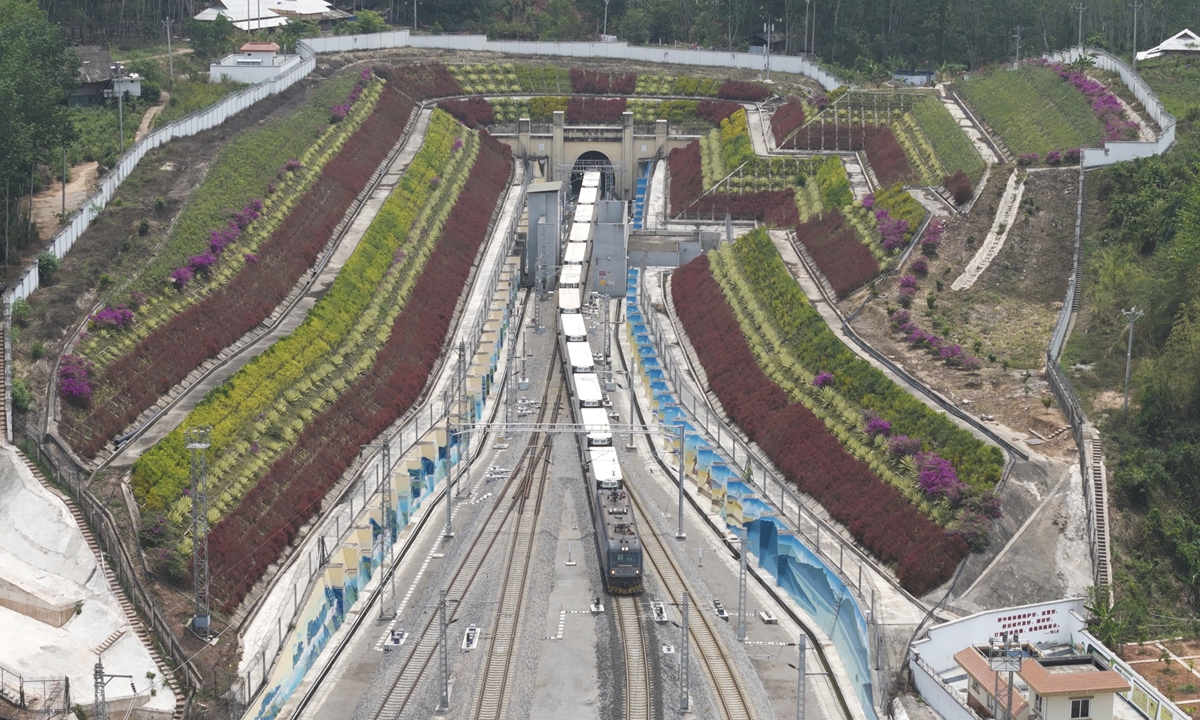
A cargo train runs along the China-Laos Railway. File photo: Courtesy of China Railway Kunming Group
Trade via the China-Laos Railway surpassed 20 billion yuan ($2.96 billion) in the first seven months of the year, up 29.9 percent year-on-year, customs data showed. The infrastructure project is further expanding its spillover effects on trade and cooperation among ASEAN members.
As the railway continues to serve as a new engine for regional economic connectivity, the cross-border infrastructure project is expanding its cargo portfolio and injecting fresh momentum into trade and development across ASEAN economies, Chinese analysts said.
Since its launch in 2021, the railway has handled more than 94 billion yuan worth of cross-border cargo, with the range of transported goods expanding from more than 10 categories at the initial stage of operation to more than 3,900, including new-energy vehicles (NEVs), tropical fruits, temperate vegetables and traditional Chinese medicine.
The line connects 19 countries and regions and provides sustained momentum for regional trade cooperation, the data showed.
To date, the China-Laos Railway has served more than 7,000 foreign trade operators in China.
In recent months, as ASEAN members enter the peak season for fruit exports via the China-Laos Railway, agricultural products from countries along the route are gaining wider access to the Chinese market, while advanced Chinese industrial products are emerging as new drivers of cross-border trade growth, with the cargo mix continuously evolving to better meet market demand.
In the first half of 2026, imports of tropical fruits via the China-Laos Railway totaled 4.22 billion yuan, up 25.8 percent year-on-year, according to customs data cited by the Xinhua News Agency on July 22.
Foreign trade of NEVs, lithium batteries and photovoltaic products via the railway totaled 2.14 billion yuan in the first half of 2026, up 348.5 percent year-on-year, emerging as a new highlight of cross-border trade growth, the report showed.
The continued expansion of cargo categories reflects the transformation of the corridor from a single-purpose cross-border transport route into a key link connecting regional industrial chains.
The differentiated two-way trade structure reflects the complementary strengths of economies along the route, matching their resource advantages and industrial needs, Bian Yongzu, executive deputy editor-in-chief of Modernization of Management magazine, told the Global Times.
"Combined with multimodal transport services and streamlined customs measures, the China-Laos Railway has evolved beyond a cross-border transport route into a practical platform for resource complementarity, industrial coordination, and greater connectivity among Lancang-Mekong countries," Bian added.
Global Times
。
Current article:http://lrp19z.shuosongzoutunchutao.cfd/gw1tg/3hlz6x.html
Published on:13:53:10